
Content status: Review draft, do not publish.
This article replaces the live post “Domestic Violence Therapy Secrets Revealed: What Experts Don't Want You to Know About Australia's New Treatment Guidelines” and its duplicate live copies with the suffixes -5 and -6.
Experiencing domestic or family violence can affect your sense of safety, trust, health and connection with other people. You may be dealing with physical violence, threats, coercive control, emotional abuse, financial abuse, sexual violence or technology-facilitated abuse. You do not need to have all the answers before asking for support.
Australian guidance increasingly emphasises trauma-informed, respectful and person-centred care. This means your safety, privacy, choices and individual circumstances should guide conversations about support. Therapy is not about blaming you or pressuring you to make a particular decision. It is about creating a safe space to discuss what you are experiencing and consider options at your own pace.
If you are in immediate danger, call 000. For crisis support, contact Lifeline on 13 11 14. For domestic and family violence support, contact Full Stop Australia on 1800 943 539.
WHAT AUSTRALIA’S GUIDELINES SAY ABOUT DOMESTIC VIOLENCE SUPPORT
There is not one single therapy that is suitable for every person affected by domestic and family violence. Australian clinical guidance, including the Royal Australian College of General Practitioners’ (RACGP) Abuse and violence guideline, supports a flexible approach based on safety, risk, personal preferences and clinical needs.
A trauma-informed approach generally means that a health professional will:
- Prioritise your physical and emotional safety.
- Listen without judgement.
- Avoid asking you to repeat distressing information unnecessarily.
- Explain what is happening and why.
- Support your choice and control.
- Work collaboratively rather than telling you what you must do.
- Consider practical issues such as housing, finances, children, transport and privacy.
- Connect you with specialist domestic and family violence services where appropriate.
The RACGP describes a first-line response using the LIVES framework:
- Listen with empathy.
- Inquire about your needs and concerns.
- Validate your experience.
- Ensure your safety.
- Support you with information, referrals and options.
These principles can apply whether you are currently living with violence, considering leaving, have left a relationship, or are affected by violence from a family member.
For more detailed information, you can read the RACGP guidance on trauma- and violence-informed care and its guidance on ongoing support and counselling after intimate partner violence.
WHAT YOU MIGHT BE NOTICING
People respond to violence and prolonged fear in different ways. Your response may change over time and can be affected by your current level of safety.
You might notice:
- Anxiety, panic or a constant feeling of being on alert.
- Low mood, sadness, shame or hopelessness.
- Difficulty sleeping or frequent nightmares.
- Feeling disconnected, numb or unable to concentrate.
- Physical symptoms such as headaches, tension, stomach discomfort or fatigue.
- Flashbacks or distressing memories.
- Fear of making decisions or upsetting someone.
- Difficulty trusting people, including supportive friends or professionals.
- Feeling responsible for another person’s behaviour.
- Changes in appetite, alcohol use or other coping behaviours.
- Concern about how violence has affected your children or other family members.
These experiences do not mean that you are weak or at fault. They can be responses to stress, fear and harm. Only a qualified health professional can diagnose a mental health condition. An appointment can provide an opportunity to discuss what you are experiencing and consider whether an assessment, therapy, medical support or another referral may be appropriate.

HOW DOMESTIC VIOLENCE THERAPY MAY SUPPORT YOU
Therapy is tailored to the individual. You remain involved in decisions about what is discussed and which approaches are considered.
Depending on your circumstances, therapy may involve:
SAFETY AND STABILISATION
Early conversations may focus on your immediate wellbeing, emotional regulation and practical safety. This could include identifying safe ways to communicate, considering privacy when booking appointments, and discussing support for children or other people in your care.
Therapy does not replace emergency services, legal advice, housing support or specialist family violence services. Your clinician may discuss referrals when additional support is needed.
UNDERSTANDING THE IMPACT OF VIOLENCE
You may explore how fear, coercion or trauma have affected your thoughts, feelings, relationships, physical health and daily life. Understanding these responses can help you make sense of your experience without placing responsibility for the violence on you.
COPING STRATEGIES
Sessions may include practical strategies for managing distress, sleep difficulties, strong emotions, panic or unwanted memories. These strategies are discussed according to your readiness and preferences.
PSYCHOLOGICAL THERAPIES
Depending on your needs and the clinician’s qualifications, therapy may draw on approaches such as cognitive behavioural therapy, motivational interviewing, mindfulness-based cognitive strategies or other evidence-informed psychological methods.
Trauma-focused therapy may be considered when it is clinically appropriate and adequate safety has been established. The RACGP notes that people experiencing post-traumatic stress disorder may be referred for trauma-informed therapy when they are no longer experiencing violence. The timing and suitability of any approach should be discussed with a qualified professional.
SUPPORT WITH DECISION-MAKING
You may feel uncertain about what to do next. This is common in situations involving fear, financial dependence, children, housing, cultural expectations or ongoing contact with a former partner.
A clinician can help you explore options without pressuring you to leave, stay, report, disclose or take a particular action. Your safety and circumstances remain central.
If you are concerned about your own use of violence, individual therapy may not be the only support needed. Specialist men’s behaviour change or family violence programs may be appropriate. Couples therapy is not a substitute for these services where there is current violence, coercive control or a significant safety risk.
You can read more about individual psychology services and couples and family therapy.
Book near you
If you would like to talk to someone, you can start with a question. No referral is needed for a private appointment.
Book online or call 1300 947 477.
Our psychologists in Croydon are at Suite 3, 19 Lacey Street, Croydon VIC 3136 — street parking, one flight of stairs, and Croydon station on the Lilydale line. Appointments are also available at our Lilydale, Mitcham and Clyde North clinics, or by secure telehealth.
If a phone call, email or appointment reminder could create a safety concern, mention this when you make contact so arrangements can be discussed carefully.
WHAT TO EXPECT IN A FIRST APPOINTMENT
Your first appointment is an opportunity to discuss what brings you to support. You do not have to share every detail straight away.
The clinician may ask about:
- What has been happening.
- How you are feeling physically and emotionally.
- Whether you feel safe at home or elsewhere.
- Whether children or other family members may be affected.
- Any immediate concerns about contact, privacy or communication.
- Previous support you have accessed.
- What you would like help with now.
You can ask questions about confidentiality, record keeping, referrals and the clinician’s approach. If you are concerned that someone may monitor your phone, email or appointment reminders, mention this when contacting the clinic so communication can be discussed carefully.
The first appointment may include assessment and planning, but it does not require you to commit to a particular therapy or outcome. Sessions can be adjusted as your needs change.
SUPPORT AT INSPIRE HEALTH AND MEDICAL
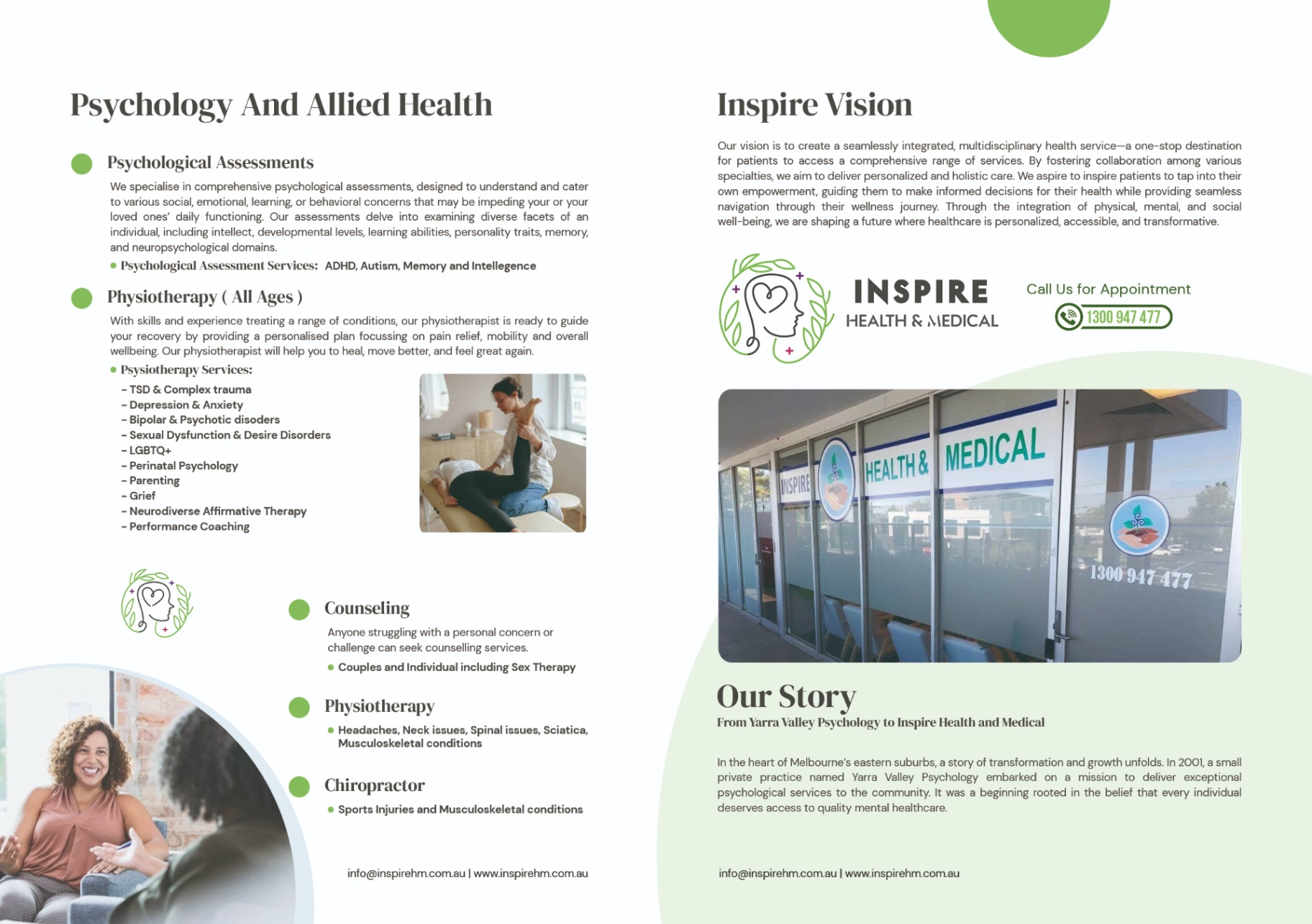
Inspire Health and Medical provides psychology and counselling services in a welcoming, inclusive setting. You can contact the clinic directly. No referral is needed to ask about support or make an appointment. A GP referral and Mental Health Care Plan may be needed if you are seeking a Medicare rebate for eligible psychology services.
Support may include:
- Individual psychology.
- Counselling.
- Assessment of anxiety, depression, trauma-related concerns and other mental health issues.
- Referrals to medical, legal, housing or specialist family violence services when appropriate.
- Coordination with other health professionals, with your consent and subject to relevant privacy and safety requirements.
You can review the Inspire Health and Medical clinicians to learn more about the different professional roles available. You can also explore the student counselling program if reduced-fee supervised counselling may be suitable for your circumstances.
OUR CROYDON CLINIC
The Croydon head office is located at:
Suite 3, 19 Lacey Street
Croydon VIC 3136
Street parking is available. There is one flight of stairs into the clinic. Croydon Station is on the Lilydale train line.
If accessibility, privacy or travel arrangements are a concern, please discuss this with the reception team before booking. You may also ask whether another appointment format or location is suitable.
FEES
The current listed fees for relevant clinical services are:
| Service | Fee | Medicare rebate | Out-of-pocket amount |
|---|---|---|---|
| Clinical Psychology | $265 | $149 | $116 |
| General Psychology | $215 | $102 | $113 |
| Counselling / Provisional Psychologist | $125 | – | – |
| Counselling / Provisional Psychologist after hours | $135 | – | – |
| Accredited Mental Health Clinician: 50-minute session | $200 | – | – |
Medicare eligibility depends on your circumstances and the requirements of the relevant Medicare item. You can view the fees and charges before making an appointment.
FREQUENTLY ASKED QUESTIONS
1. Do I need a referral for domestic violence therapy?
No referral is needed to contact Inspire Health and Medical or ask about counselling and psychology services. If you want to claim a Medicare rebate for eligible psychology sessions, you may need a GP referral and Mental Health Care Plan.
2. What if I am still living with the person using violence?
You can still ask for support. Your safety should be considered before detailed discussions about violence or trauma. Let the clinic know if phone calls, emails, appointment reminders or online bookings could create a risk. If you are in immediate danger, call 000.
3. Can therapy diagnose PTSD or another mental health condition?
Only a qualified professional can diagnose a mental health condition. A psychologist, psychiatrist or medical practitioner may assess your symptoms, history and circumstances and discuss whether further assessment or treatment is appropriate.
4. Is couples therapy suitable when domestic violence is involved?
Couples or family therapy is not suitable in every situation. Where there is current violence, coercive control, intimidation or a safety concern, separate support and specialist family violence services may be more appropriate. A qualified clinician can discuss the options with you.
5. Can I receive a Medicare rebate?
A Medicare rebate may be available for eligible psychology services when the relevant requirements are met, such as having an appropriate GP referral and Mental Health Care Plan. Counselling and other services may not attract a Medicare rebate. Fees and rebate arrangements should be confirmed before your appointment.
GET SUPPORT WHEN YOU FEEL READY
You do not have to explain everything before reaching out. You can begin by asking a question, discussing your options or arranging an appointment that feels safe for you.
If you are in immediate danger, call 000. For crisis support, contact Lifeline on 13 11 14. For domestic and family violence support, contact Full Stop Australia on 1800 943 539.
To speak with Inspire Health and Medical, call 1300 947 477 or use the Book Now service. Your experience matters, and support can be discussed at a pace that respects your safety, privacy and choices.